Congratulations to Faculty of the Year Award Winner: Aaron Kaat, PhD
July 6, 2026
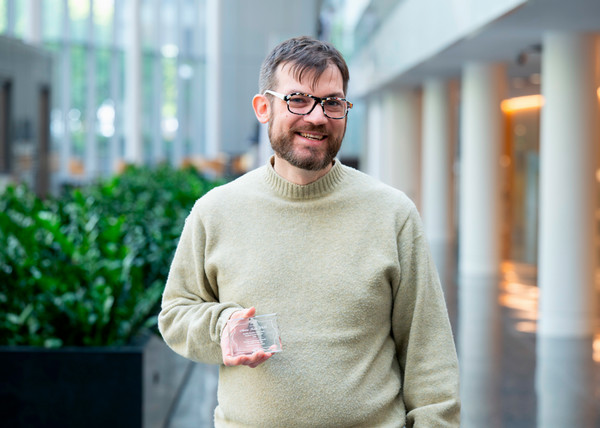
Pictured Above: Aaron Kaat, PhD
What does receiving Northwestern University Department of Medical Social Sciences Faculty of the Year Award mean to you personally and professionally?
I am honored to receive the MSS Faculty of the Year Award. I was personally quite moved by all the kind words that my nominators had to say about me. If a job is worth doing, it is worth doing well. I want others to succeed and do their job well too. It feels good to be appreciated and recognized for the little things that come along with the job.
Can you share a moment or project from this past year that you’re especially proud of and why it stands out?
The NIH Baby Toolbox (NBT) had its final project year last year. I served as the Scientific Director under PI Richard Gershon, PhD. I am especially proud of that effort; it was 5 years in the making. I was able to work closely with the NBT analytic team, bringing on a postdoc and seeing them succeed and achieve a faculty position; and I worked with the scientific teams and saw some of our more junior faculty take on leadership roles as domain managers (and they are now leading efforts to get new funding to sustain the NBT); and I worked with Richard and the NBT leadership team, which helped me learn how to manage large research efforts. I proud of the things I've learned through that process, and I'm proud of the NBT, the papers we were able to publish on it (including an entire special issue), and I'm especially proud of the team and how I've been able to watch them develop over the last 5 years.
Colleagues often recognize people for how they support others. How would you describe your approach to working with and helping your team?
I don't really have my own team. I have people I manage, but they generally work on other people's projects. On the projects I lead, I have faculty and staff who support the research efforts, but they are "officially" part of other teams. On the one hand, that makes it hard to work as a team because there is not just one team. But on the other hand, it means I get to interact with lots of people—primarily across the division of Outcomes and Measurement Science but also in other divisions as well. Because they are opportunistic teams rather than one established team, my approach focuses on listening to their needs and trying to learn from them what they have to teach me. I have to be willing to receive help from them if I am going to be able to provide help too. And I don't just mean the faculty here—its the staff who do the majority of the day-to-day work, so it has to be learning from them too. Hopefully, along the way, we all do our job a little bit better.
What motivates you in your day-to-day work, even during busy or challenging periods?
Honestly, some days are hard to stay motivated, especially in challenging times. This is where projects that "matter" are key. Some projects have a clearer connection to "the real world" than other projects, but all of our work is aimed at improving the health and well-being of real people. When it is hard to stay motivated, I try to remind myself of those impacts (and sometimes that means prioritizing the work in that moment where I can see and feel those real-world connections better).
Looking ahead, what are you excited about for your team, department, or future work?
Last year was a very challenging year for all of academe, myself included. But it was also a year where personally I experienced a lot of success. Looking forward, it is a time of transition for me. After over 11 years at Northwestern, I am entering a transition period as a move out of MSS to Rush University Medical Center (beginning in mid-September 2026). I am excited for this new chapter in my career. I will continue to collaborate with Northwestern research teams in the future but it will be in a different capacity. Nonetheless, I am excited for MSS, even though it will be without me. MSS's Methodological Institutes have been quite successful, and I look forward to handing off their leadership to the next Director of Educational Initiatives. And as I mentioned earlier, I have already seen a lot of professional growth among the faculty more junior than myself within some of the large-scale projects I have worked on; I look forward to seeing them continue to succeed, however that looks for them. But mostly, I look forward to hearing how MSS continues to improve health and well-being: that is the mission, that is why the department is here, and that needs to be the true metric by which we measure success.