JAMA Pediatrics Study Led by Rinad Beidas, PhD, Wins Greenwald Award for Excellence in Firearm Violence Research
December 11, 2025
By: Julie A. Bednark
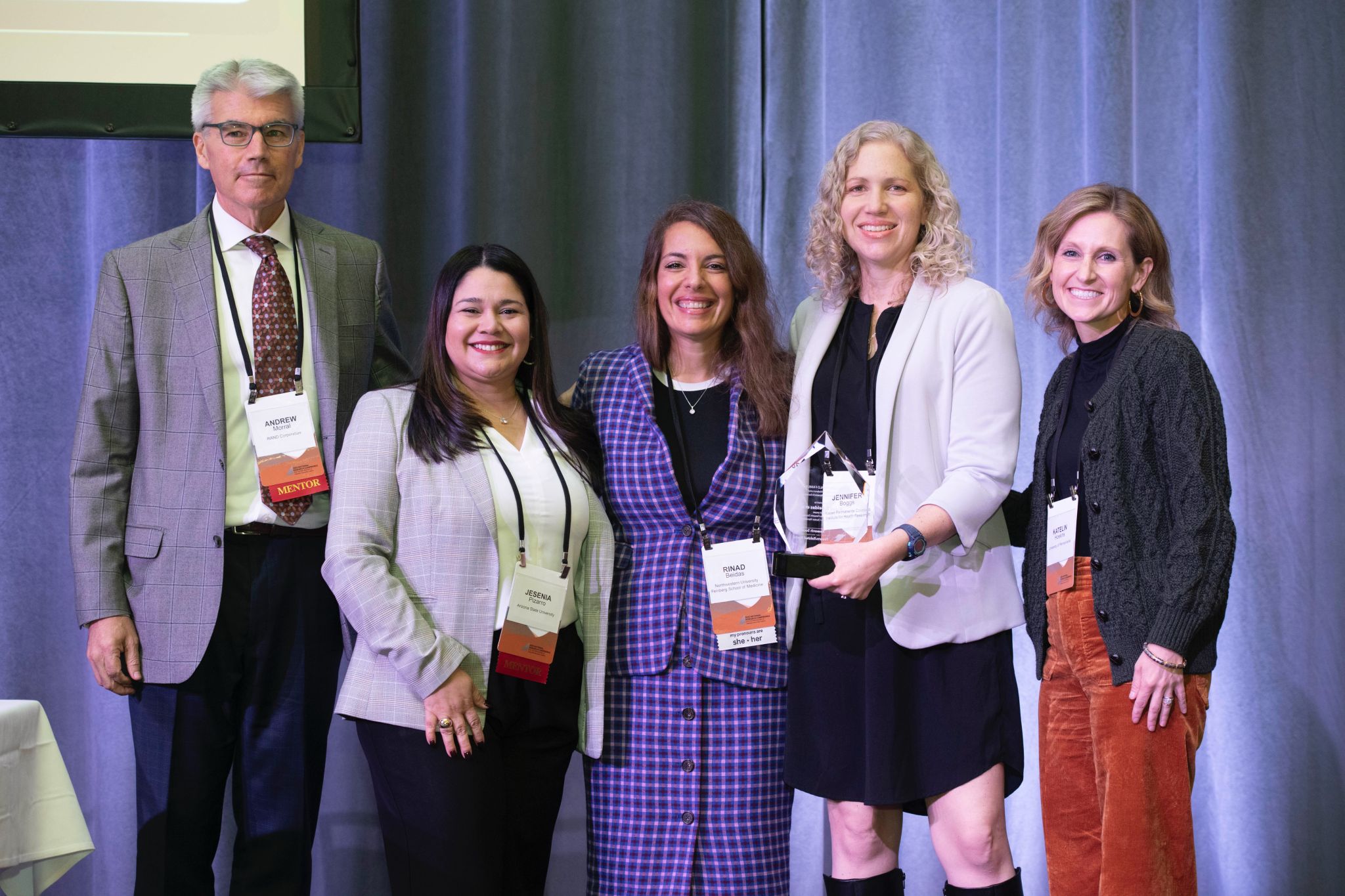
Pictured above left to right: Andrew Morral, Jesenia Pizarro, Rinad Beidas, Jennifer Boggs, Katelin Hoskins
A landmark JAMA Pediatrics study led by Rinad S. Beidas, PhD, of Northwestern University Feinberg School of Medicine Department of Medical Social Sciences, has been named the winner of the 2025 Greenwald Family Award for Excellence in Research on Firearm Violence Prevention. The honor recognizes Dr. Beidas and colleagues’ rigorously designed cluster randomized trial, which offers one of the clearest paths to date for embedding evidence-based secure firearm storage approaches into routine pediatric primary care. This work was conducted in collaboration with Kaiser Permanente Colorado; Henry Ford Health; and the University of Pennsylvania.
The award-winning paper, “Implementation of a Secure Firearm Storage Program in Pediatric Primary Care,” was published in JAMA Pediatrics in September 2024. Conducted across 30 clinics and more than 47,000 well child visits in two diverse health systems in Michigan and Colorado, the ASPIRE trial evaluated strategies to increase implementation of the S.A.F.E. Firearm program. This program pairs brief discussions on secure firearm storage between pediatric clinicians and parents with the distribution of a free cable lock.
Beidas’ interest in this work began after a firearm suicide in her family and a subsequent routine pediatric visit with her newborn that sparked an “aha” moment. She thought, “pediatricians spend time discussing safety topics including fire and car safety. There is an opportunity to discuss firearm safety.” She and her team have since spent over a decade examining how health systems can close the long-standing gap between existing evidence on secure firearm storage programs and practice. “Prior research has shown that secure firearm storage meaningfully reduces risk for firearm injury in young people, and the American Academy of Pediatrics recommends that pediatricians talk to parents about secure firearm storage. And yet, we know this is rarely done in routine practice,” Beidas said. “Health systems nationwide have been eager to take action to keep children and communities safe from firearm injury. Our trial provides a roadmap for how they can do this.”
The ASPIRE trial compared two packages of implementation strategies. Both study arms used an electronic health record reminder plus training for clinicians. One arm added facilitation delivered by a health system employee who was external to the clinics. The facilitator spent approximately one hour per month providing tailored support to each of the clinics, including workflow problem solving and education. Clinics receiving the package of strategies that included facilitation saw nearly double the rate of delivery of S.A.F.E. Firearm compared with the approach that consisted of just training and the electronic health record prompt: 49 percent versus 22 percent of eligible visits.
Christina Johnson, MPH, a coauthor on the study, noted that, consistent with prior literature, the free lock distribution may have been a critical ingredient of the study’s success. Pediatricians appreciated being able to give families something to help them take action to secure their firearms, rather than only having a discussion about the importance of secure firearm storage and telling them to go home and buy a locking device themselves. “Pediatricians in our study told us it feels easier when they can actually give someone the tools to make the change that day,” she said.
The Greenwald Award judges described the study as setting “a new standard for implementation excellence in pediatric population health,” noting that its policy relevance is immediate and actionable. The commendation emphasized that health system leaders and policymakers can deploy these low-resource strategies now to embed firearm safety discussions and device distribution at scale.
Gerald Greenwald, co-founder of Greenbriar and a Greenwald Family Impact Foundation donor, applauded the selection. “In auto safety, evidence transformed industry practices and saved countless lives,” Greenwald said. “This award exists to spotlight equally rigorous research on firearm injury prevention. Dr. Beidas and her colleagues have delivered a playbook that health systems can deploy now to protect children.”
Interest in S.A.F.E. Firearm is already expanding beyond the two health systems, Kaiser Permanente Colorado and Henry Ford Health, in which the ASPIRE trial was conducted. The research team reported that they had shared S.A.F.E. Firearm program materials with over twenty-five clinicians and health systems who have expressed interest in bringing the program in their settings. Additionally, the team is conducting two new trials that are currently underway to adapt and test the S.A.F.E. Firearm program and implementation strategies for community health centers in Illinois as well as adult primary care and women’s health and obstetrics and gynecology in the ASPIRE trial’s funded by the National Institute of Nursing Research and National Institute of Mental Health. The team’s long-term vision is national implementation.
“Our goal is to reach as many families as possible because at the end of the day, we have a shared mission to keep young people safe,” Beidas said.
The Greenwald Award honors research published in the past two years that significantly advances understanding of firearm violence or its prevention with clear implications for policy and practice. This year’s independent judging panel included Richard Carmona, the seventeenth Surgeon General of the United States and current Distinguished Professor of Public Health at the University of Arizona; Janet Napolitano, former United States Secretary of Homeland Security and former president of the University of California system; Peter Reuter, PhD, Distinguished University Professor at the University of Maryland; and John Rich, MD, Inaugural Director of the RUSH BMO Institute for Health Equity.
Along with lead author Beidas, authors include Kristin A. Linn, Jennifer M. Boggs, Steven C. Marcus, Katelin Hoskins, Shari Jager Hyman, Christina Johnson, Melissa Maye, LeeAnn Quintana, Courtney Benjamin Wolk, Leslie Wright, Celeste Pappas, Arne Beck, Katy Bedjeti, Alison M. Buttenheim, Matthew F. Daley, Marisa Elias, Jason Lyons, Melissa Lynne Martin, Bridget McArdle, Debra P. Ritzwoller, Dylan S. Small, Nathaniel J. Williams, Shiling Zhang, and Brian K. Ahmedani.
For more information on the S.A.F.E. Firearm program, please visit https://safe-firearm.org/ or email: safefirearm@northwestern.edu.